

Transcription
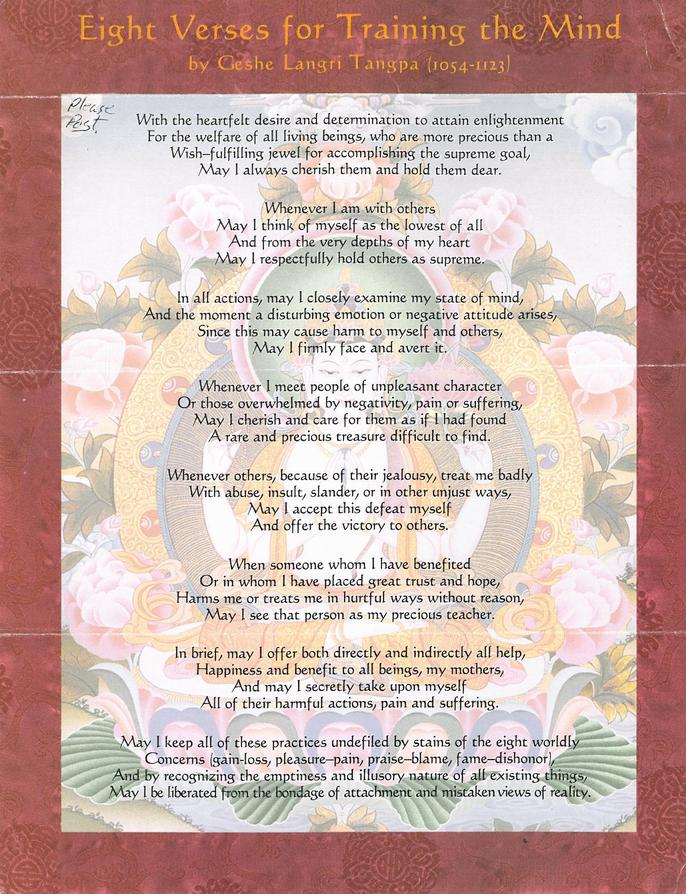
EIGHT VERSES FOR TRAINING THE MIND
By Geshe Langri Tangpa (1054-1123)
With the heartfelt desire and determination to attain enlightenment
For the welfare of all living beings, who are more precious than a
Wish-fulfilling jewel for accomplishing the supreme goal,
May I always cherish them and hold them dear.
Whenever I am with others
May I think of myself as the lowest of all
And from the very depths of my heart
May I respectfully hold others as supreme.
In all actions, may I closely examine my state of mind,
And the moment, a disturbing emotion or negative attitude arises,
Since this may cause harm to myself and others,
May I firmly face and avert it.
Whenever I meet people of unpleasant character
Or those overwhelmed by negativity, pain or suffering,
May I cherish and care for them as if I had found
A rare and precious treasure difficult to find.
Whenever others, because of their jealousy, treat me badly
With abuse, insult, slander, or in other unjust ways,
May I accept this defeat myself
And to offer the victory to others.
When someone whom I have benefited
Or in whom I have placed great trust and hope,
Harms me or treats me in hurtful ways without reason,
May I see that person as my precious teacher.
In brief, may I offer both directly and indirectly all help,
Happiness and benefit to all beings, my mothers,
And may I secretly take upon myself
All of their harmful actions, pain and suffering.
May I keep all of these practices undefiled by stains of the eight worldly
Concerns (gain-loss, pleasure-pain, praise-blame, fame-dishonor),
And by recognizing the emptiness and illusory nature of all existing things,
May I be liberated from the bondage of attachment and mistaken views of reality.
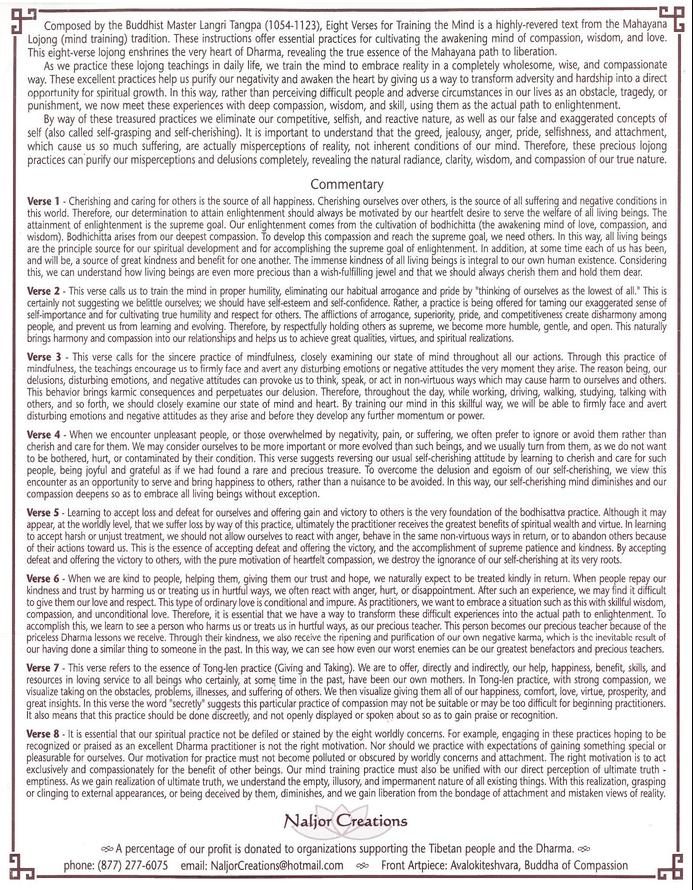
Composed by the Buddhist Master Langri Tangpa (1054-1123), Eight Verses for Training the Mind is a highly-revered text form the Mahayana Lojong (mind training) tradition. These instructions offer essential practices for cultivating the awakening mind of compassion, wisdom, and love. This eight-verse lojong enshrines the very heart of Dharma, revealing the true essence of the Mahayana path to liberation.
As we practice these lojong teachings in daily life, we train the mind to embrace reality in a completely wholesome, wise and compassionate way. These excellent practices help us purify our negativity and awaken the heart by giving us a way to transform adversity and hardship into a direct opportunity for spiritual growth. In this way, rather than perceiving difficult people and adverse circumstances in our lives as an obstacle, tragedy, or punishment, we now meet these experiences with deep compassion, wisdom, and skill, using them as the actual path to enlightenment.
By way of these treasured practices we eliminate our competitive, selfish, and reactive nature, as well as our false and exaggerated concepts of self (also called self-grasping and self-cherishing). It is important to understand that the greed, jealousy, anger, pride, selfishness, and attachment, which cause us so much suffering, are actually misperceptions of reality, not inherent conditions of our mind. Therefore, these precious lojong practices can purify our misperceptions and delusions completely, revealing the natural radiance, clarity, wisdom, and compassion of our true nature.
Verse 1 - Cherishing and caring for others is the source of all happiness. Cherishing ourselves over others, is the source of all suffering and negative conditions in this world. Therefore, our determination to attain enlightenment should always be motivated by our heartfelt desire to serve the welfare of all living beings. The attainment of enlightenment is the supreme goal. Our enlightenment comes from the cultivation of bodhichitta (the awakening mind of love, compassion, and wisdom). Bodhichitta arises from our deepest compassion. To develop this compassion and reach the supreme goal, we need others. In this way, all living beings are the principle source for our spiritual development and for accomplishing the supreme goal of enlightenment. In addition, at some time each of us has been, and will be, a source of great kindness and benefit for one another. The immense kindness of all living beings is integral to our own human existence. Considering this, we can understand how living beings are even more precious than a wish-fulfilling jewel and that we should always cherish them and hold them dear.
Verse 2 - This verse calls us to train the mind in proper humility, eliminating our habitual arrogance and pride by "thinking of ourselves as the lowest of all." This is certainly not suggesting we belittle ourselves; we should have self-esteem and self-confidence. Rather, a practice is being offered for taming our exaggerated sense of self-importance and for cultivating true humility and respect for others. The afflictions of arrogance, superiority, pride, and competitiveness create disharmony among people, and prevent us from learning and evolving. Therefore, by respectfully holding others as supreme, we become more humble, gentle, and open. This naturally brings harmony and compassion into our relationships and helps to achieve great qualities, virtues and spiritual realizations.
Verse 3 - This verse calls for the sincere practice of mindfulness, closely examining our state of mind throughout all our actions. Through this practice of mindfulness, the teachings encourage us to firmly face and avert any disturbing emotions or negative attitudes the very moment they arise. The reason being, our delusions, disturbing emotions, and negative attitudes can provoke us to think, speak, or act in non-virtuous ways which may cause harm to ourselves and others. This behavior brings karmic consequences and perpetuates our delusion. Therefore, throughout the day, while working, driving, walking, studying, talking with others, and so forth, we should closely examine our state of mind and heart. By training our mind in this skillful way, we will be able to firmly face and avert disturbing emotions and negative attitudes as they arise and before they develop any further momentum and power.
Verse 4 - When we encounter unpleasant people, or those overwhelmed by negativity, pain, or suffering, we often prefer to ignore or avoid them rather than cherish and care for them. We may consider ourselves to be more important or more evolved than such beings,and we usually turn from them, as we do not want to be bothered, hurt, or contaminated by their condition. This verse suggests reversing our usual self-cherishing attitude by learning to cherish and care for such people, being joyful and grateful as if we had found a rare and precious treasure. To overcome the delusion and egoism of our self-cherishing, we view this encounter as an opportunity to serve and bring happiness to others, rather than a nuisance to be avoided. In this way, our self-cherishing mind diminishes and our compassion deepens so as to embrace all living beings without exception.
Verse 5 - Learning to accept loss and defeat for ourselves and offering gain and victory to others is the very foundation of the bodhisattva practice. Although it may appear, at the worldly level, that we suffer loss by way of this practice, ultimately the practitioner receives the greatest benefits of spiritual wealth and virtue. In learning to accept harsh or unjust treatment, we should not allow ourselves to react with anger, behave in the same non-virtuous ways in return, or to abandon others because of their actions toward us. This is the essence of accepting defeat and offering the victory, and the accomplishment of supreme patience and kindness. By accepting defeat and offering the victory to others, with the pure motivation of heartfelt compassion, we destroy the ignorance of our self-cherishing at its very roots.
Verse 6 - When we are kind to people, helping them, giving them our trust and hope, we naturally expect to be treated kindly in return. When people repay our kindness and trust by harming us or treating us in hurtful ways, we often react with anger, hurt, or disappointment. After such an experience, we may find it difficult to give them our love and respect. This type of ordinary love is conditional and impure. As practitioners, we want to embrace a situation such as this with skillful wisdom, compassion, and unconditional love. Therefore, it is essential that we have a way to transform these difficult experiences into the actual path to enlightenment. To accomplish this, we learn to see a person who harms us or treats us in hurtful ways, as our precious teacher. This person becomes our precious teacher because of the priceless Dharma lessons we receive. Through their kindness, we also receive the ripening and purification of our own negative karma, which is the inevitable result of our having done a similar thing to someone in the past. In this way, we can see how even our worst enemies can be our greatest benefactors and precious teachers.
Verse 7 - This verse refers to the essence of Tong-len practice (Giving and Taking). We are to offer, directly and indirectly, our help, happiness, benefit, skills, and resources in loving service to all beings who certainly, at some time in the past, have been our own mothers. In Tong-len practice, with strong compassion, we visualize taking on the obstacles, problems, illnesses, and suffering of others. We then visualize giving them all of our happiness, comfort, love, virtue, prosperity, and great insights. In this verse the word "secretly" suggests this particular practice of compassion may not be suitable or may be too difficult for beginning practitioners. It also means that this practice should be done discreetly, and not openly displayed or spoken about so as to gain praise or recognition.
Verse 8 - It is essential that our spiritual practice not be defiled or stained by the eight worldly concerns. For example, engaging in these practices hoping to be recognized or praised as an excellent Dharma practitioner is not the right motivation. Nor should we practice with expectations of gaining something special or pleasurable for ourselves. Our motivation for practice must not become polluted or obscured by worldly concerns and attachment. The right motivation is to act exclusively and compassionately for the benefit of other beings. Our mind training practice must also be unified with our direct perception of ultimate truth - emptiness. As we gain realization of ultimate truth, we understand the empty, illusory, and impermanent nature of all existing things. With this realization, grasping or clinging to external appearances, or being deceived by them, diminishes, and we gain liberation from the bondage of attachment and mistaken views of reality.
Naljor Creations
A percentage of our profit is donated to organizations supporting the Tibetan people and the Dharma.
phone: (877) 277-6075 email: NaljorCreations@hotmail.com * Front Artpiece: Avalokiteshvara, Buddha of Compassion
Other posts by this author
|
2014 may 10

|
2014 may 10

|
2014 may 10

|
2014 apr 23

|
2014 jan 18

|
2014 jan 17

|
More... |
 RSS
RSS
Replies