

uploaded Dec. 25, 2025.
Original (PDF)
Transcription
Dymitri Haraszewski Blog #1660
"I Don't Wanna be a Pinhead No more": Thomas Merton, "Rehabilitation" and Brainwashing
11-26-25
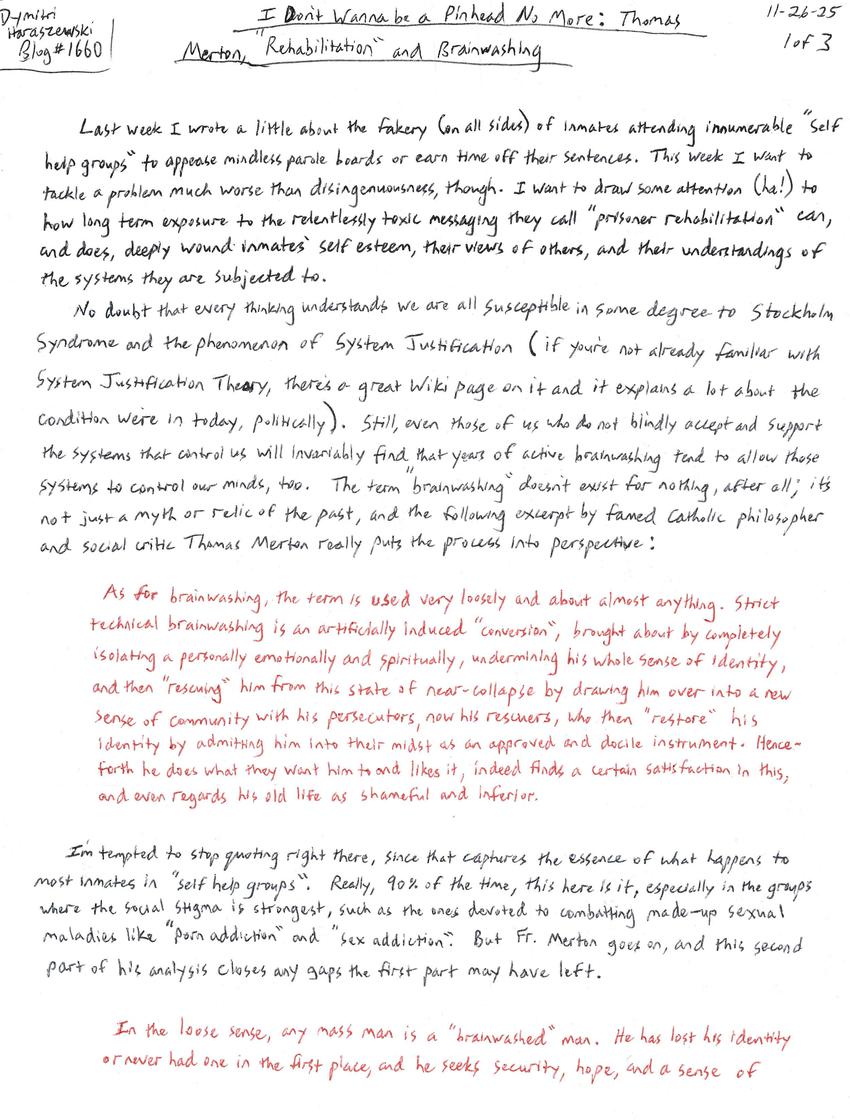
Last week I wrote a little about the fakery (on all sides) of inmates attending innumerable "self help groups" to appease mindless parole boards or earn time off their sentences. This week I want to tackle a problem much worse than disingenuousness, though. I want to draw some attention (ha!) to how long term exposure to the relentlessly toxic messaging they call "prisoner rehabilitation" can and does, deeply wound inmates' self-esteem, their views of others, and their understandings of the systems they are subjected to.
No doubt that every thinking person understands we are all susceptible in some degree to Stockholm Syndrome and the phenomenon of System Justification ( if you're not already familiar with System Justification Theory, there's a great wiki page on it and it explains a lot about the condition we're in today, politically ). Still, even those of us who do not blindly accept and support the systems that control us will invariably find that years of active brainwashing tend to allow those systems to control our minds, too. The term brainwashing doesn't exist for nothing, after all; it's not just a myth or relic of the past, and the following excerpt by famed Catholic philosopher and social critic Thomas Merton really puts the process into perspective:
"As for brainwashing, the term is used very loosely and about almost anything. Strict technical brainwashing is an artificially induced "conversion", brought about by completely isolating a person emotionally and spiritually, undermining his whole sense of identity, and then "rescuing" him from this state of near-collapse by drawing him over into a new sense of community with his persecutors, now his rescuers, who then "restore" his identity by admitting him into their midst as an approved and docile instrument. Henceforth he does what they want him to and likes it, indeed finds a certain satisfaction in this, and even regards his old life as shameful and inferior."
I'm tempted to stop quoting right there, since that captures the essence of what happens to most inmates in "self help groups". Really, 90% of the time, this here is it, especially in the groups where the sexual shame is strongest, such as the ones devoted to combatting made-up sexual maladies like "porn addiction" and "sex addiction". But Fr. Merton goes on, and this second part of his analysis closes any gaps the first part may have left.
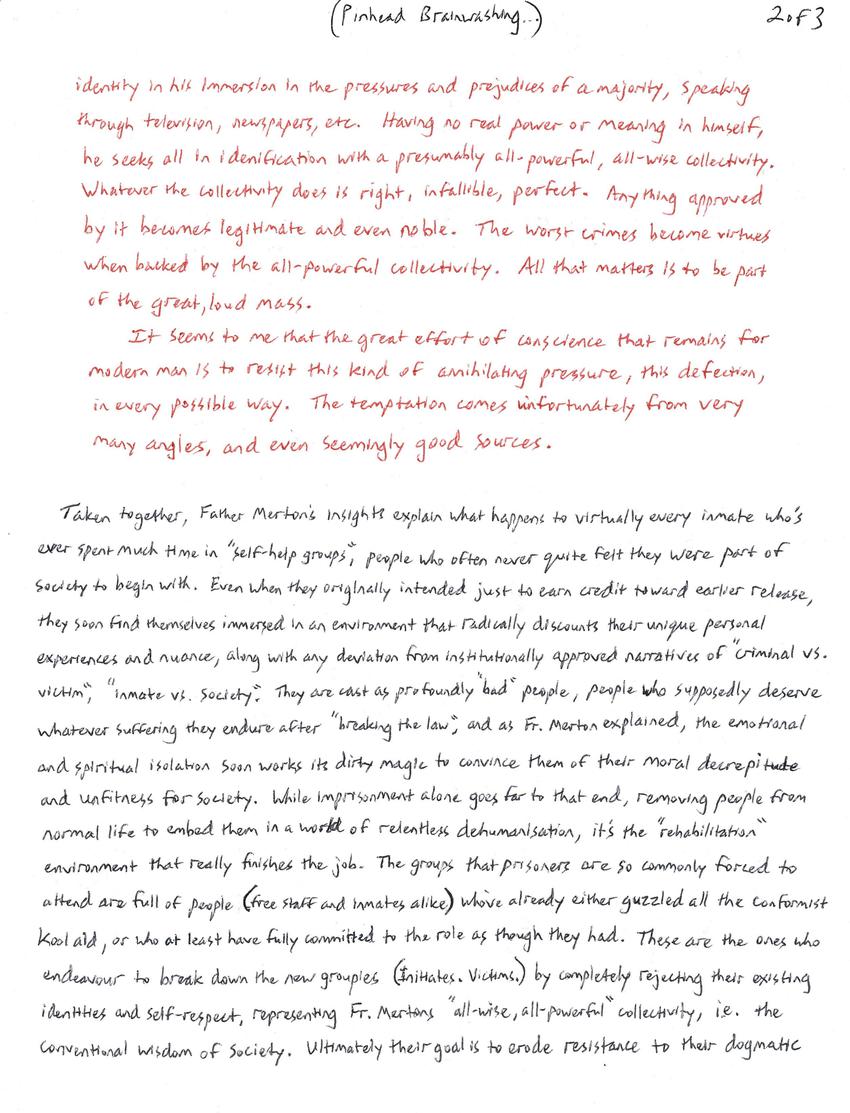
"In the loose sense, any mass man is a "brainwashed" man. He has lost his identity or never had one in the first place, and he seeks security, hope, and a sense of identity in his immersion in the pressures and prejudices of a majority, speaking through television, newspapers, etc. Having no real power or meaning in himself, he seeks all in identification with a presumably all-powerful, all-wise collectivity. Whatever the collectivity does is right, infallible, perfect. Anything approved by it becomes legitimate and even noble. The worst crimes become virtues when backed by the all-powerful collectivity. All that matters is to be part of the great, loud mass. It seems to me that the great effort of conscience that remains for modern man is to resist this kind of annihilating pressure, this defection, in every possible way. The temptation comes unfortunately from very many angles, and even seemingly good sources."
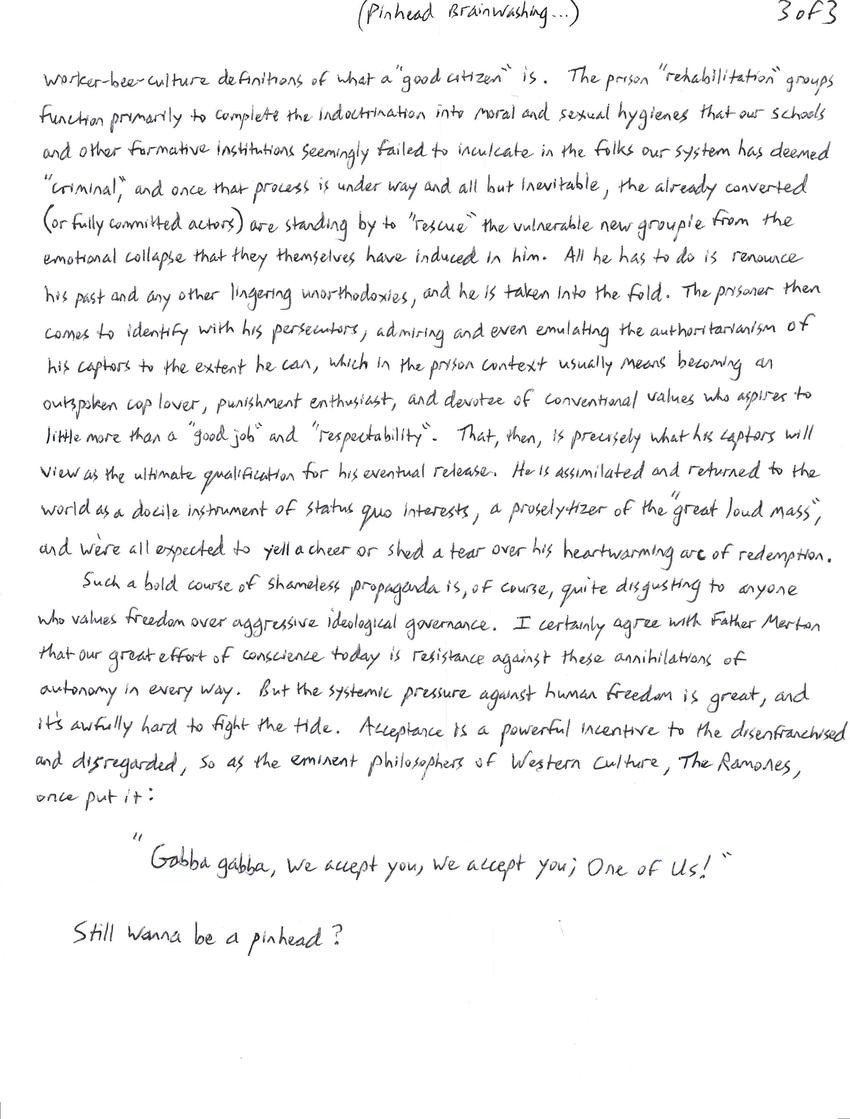
Taken together, Father Merton's insights explain what happens to virtually every inmate who's ever spent much time in "self-help groups", people who often never quite felt they were part of society to begin with. Even when they originally intended just to earn credit toward earlier release, they soon find themselves immersed in an environment that radically discounts their unique personal experiences and nuance, along with any deviation from institutionally approved narratives of "criminal vs. victim", "inmate vs. society". They are cast as profoundly "bad" people, people who supposedly deserve whatever suffering they endure after "breaking the law", and as Fr. Merton explained, the emotional and spiritual isolation soon works its dirty magic to convince them of their moral decrepitude and unfitness for society. While imprisonment alone goes far to that end, removing people from normal life to embed them in a world of relentless dehumanization, it's the "rehabilitation" environment that really finishes the job. The groups that prisoners are so commonly forced to attend are full of people (free staff and inmates alike) who've already either guzzled all the conformist Kool-aid, or who at least have fully committed to the role as though they had. These are the ones who endeavour to break down the new groupies (initiates, victims) by completely rejecting their existing identities and self-respect, representing Fr. Merton's "all-wise, all-powerful" collectivity, i.e., the conventional wisdom of society. Ultimately their goal is to erode resistance to their dogmatic worker-bee-culture definitions of what a "good citizen" is. The prison "rehabilitation" groups function primarily to complete the indoctrination into moral and sexual hygienes that our schools and other formative institutions seemingly failed to inculcate in the folks our system has deemed "criminal", and once that process is under way and all but inevitable, the already converted (or fully committed actors) are standing by to "rescue" the vulnerable new groupie from the emotional collapse that they themselves have induced in him. All he has to do is renounce his past and any other lingering unorthodoxies, and he is taken into the fold. The prisoner then comes to identify with his persecutors, admiring and even emulating the authoritarianism of his captors to the extent he can, which in the prison context usually means becoming an outspoken cop lover, punishment enthusiast, and devotee of conventional values who aspires to little more than a "good job" and "respectability". That, then, is precisely what his captors will view as the ultimate qualification for his eventual release: He is assimilated and returned to the world as a docile instrument of status quo interests, a proselytizer of the "great loud mass", and we're all expected to yell a cheer or shed a tear over his heartwarming arc of redemption.
Such a bold course of shameless propaganda is, of course, quite disgusting to anyone who values freedom over aggressive ideological governance. I certainly agree with Father Merton that our great effort of conscience today is resistance against these annihilations of autonomy in every way. But the systemic pressure against human freedom is great, and it's awfully hard to fight the tide. Acceptance is a powerful incentive to the disenfranchised and disregarded, so as the eminent philosophers of Western Culture, The Ramones, once put it:
"Gabba gabba, we accept you, we accept you, One of Us!"
Still wanna be a pinhead?
✖
Other posts by this author
|
2026 oct 2
|
2026 sep 30
|
2026 sep 28

|
2026 sep 27
|
2026 sep 13
|
2026 sep 13
|
More... |
 RSS
RSS
Replies (8)
The quotes from Father Merton are extraordinary in this particular historical time. And of course, no question how relevant they are to your specific experience, as your post makes clear. Thank you for sharing and giving us these glimpses.
I need to include you, brother, on a conversation I've been having with multiple people, an editor and someone inside. As I considered where to post my musing, it seemed to go along with the idea of brainwashing. The conversation follows as such:
This type of word appropriation is currently being employed in conservative media and the current administration with the term “illegal immigrants.” Why do I find this objectionable? It’s a broad term that encompasses various types of aliens residing in America. These include criminal aliens, formerly legally admitted but expired visa holders, non-citizens admitted for humanitarian relief under programs canceled by the current administration, and undocumented aliens (who may have entered the country decades ago when borders were more fluid). Similar to the word “offender,” using a blanket term like “illegal immigrants” conveys judgment and righteous indignation, regardless of the circumstances that led a human being deserving of respect and justice to seek refuge in a country that once served as a haven for the destitute, the persecuted, the harassed, and the needy. Criminally accused aliens, in my view, should be treated in the same way as criminally accused citizens. This does not guarantee justice, but it is the best America can do.
“One Bad Apple (Don’t Spoil the Whole Bunch, Girl)” - George Osborne
“Give me your tired, your poor, your huddled masses yearning to breathe free…” - Emma Lazarus
“You know that life really takes its toll,
And a poet's gut reaction is to search his very soul.” - Dee Dee Ramone