
uploaded Jan. 14, 2026.
Original (PDF)
Transcription
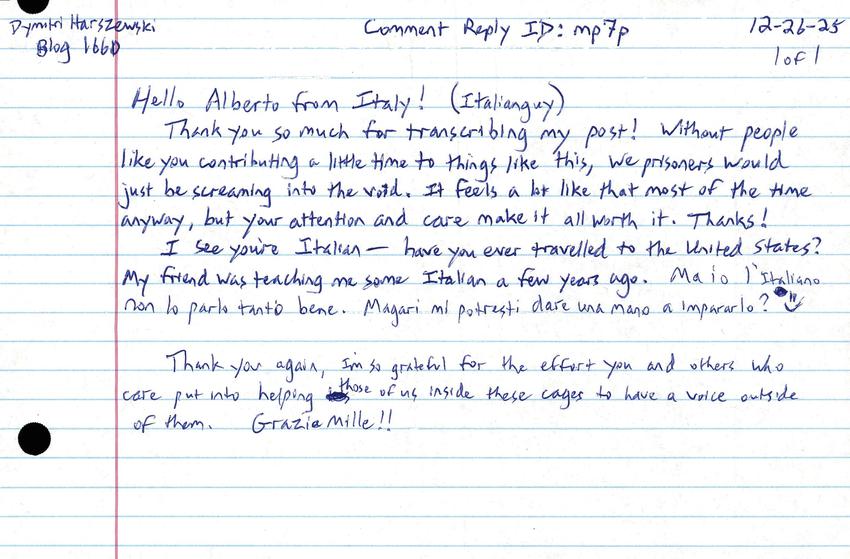
Dymitri Haraszewski Comment reply ID : mp7P
Hello Alberto from Italy! (Italianguy)
Thank you so much for transcribing my post! Without people like you contributing a little time to things like this, we prisoners would just be screaming into the void. It feels a bit like that most of the time anyway, but your attention and care make it all worth it. Thanks!
I see you are Italian - have you have travelled to the United States?
My friend was teaching me some Italian a few years ago. Ma io l'italiano non lo parlo tanto bene. Magari potresti dare una mano a impararlo?
Thank you again, I am so grateful for the effort you and others who care put into helping those of us inside these cages to have a voice outside of them. Grazie mille!!
Other posts by this author
|
2026 sep 27

|
2026 sep 13
|
2026 sep 13
|
2026 aug 30
|
2026 aug 30
|
2026 aug 7
|
More... |
 RSS
RSS
Replies (7)
It was a pleasure to transcribe your post, I am glad when I can help people, especially people who are suffering for any reason.
I am very happy to learn that my attention was appreciated by you.
I have travelled to many European countries (France, Spain, Germany, Croatia, England, Austria, Switerland, Belgium). I have never been to other continent, therefore I have never been to US.
The sentence you wrote in Italian is perfect; there is no mistakes. Congratulations!
Of course I can help you to improve your Italian.
My Italian is good since I attended University. I would like to help anyone who wants to practice my nice language and culture.
I am very happy to be able to help people to practice my language and culture as a sign of friendship between different countries and people.
It is an activity I am very happy to volunteer for, without expecting anything in return on a web site called Language Exchange.
Therefore, as I help the users of that site, I can also help you with great pleasure.
If you wish, you can write me longer sentences in Italian, and I will be happy to help you with my advice and corrections.
You can talk to me about any topic; I am a person who listens to people.
Today I would like to talk to you about the most beautiful Italian cities. Foreigners often ask me which is the most beautiful Italian city. Well, I have no hesitation in saying that the most beautiful Italian cities are: Florence, Rome, and Venice, in strict alphabetical order. These cities have a great quality and quantity of monuments and works of art; every tourist has their favorite, depending on their tastes and cultural interests. Personally, I put Rome first, for its beauty and enormous quantity of works of art and monuments, but also for its incomparable history: it was the capital of the Roman Empire and has been the seat of the Pope and therefore the center of Christianity for approximately two thousand years (aside from the period in 1300 when the Popes lived in Avignon, France). The fact that I am Catholic contributes to my choice of Rome as the most interesting city in Italy.
Adesso scrivo due righe in Italiano.
Spero che il mio inglese sia comprensibile, non è sempre facile scrivere in una lingua straniera, e l’inglese è così differente dall’italiano.
Spero anche di ricevere presto una tua risposta, sono felice di poter diventare il tuo assistente personale per migliorare il tuo italiano.(I also hope to hear from you soon. I'm happy to become your personal assistant in improving your Italian).
From you name and surname I think you should have east European origins.
I transcribe your Comment reply addressed to me.
Cordiali saluti
Alberto
Italy
I hope you are well; I just want to send you a few lines.
First, I hope you liked my reply. I think it is always interesting to receive an email from a different country.
I try to write something in Italian and then I translate it in English.
L’Italia si può dividere in tre parti per spiegarla meglio. C’è una certa differenza tra le regioni del nord, del centro e del sud. Comunque, queste divisioni sono graduali man mano che ci si sposta da nord a sud, in questo modo non si può tracciare un confine tra una parte dell’Italia e l’altra.
Il nord è la parte più moderna ed industrializzata dell’Italia e anche la più popolata. Il centro è la parte dell’Italia che meglio rappresenta la cultura italiana per la bellezza delle città e perché qui è nata la lingua italiana.
Il sud è la parte meno sviluppata della nazione, ma ha bellissimi posti, specialmente sulle coste e anche delle belle città, purtroppo lo sviluppo del sud Italia è frenato da alcune organizzazioni criminali
Ti ho solo scritto una breve descrizione delle caratteristiche della mia nazione.
Italy can be divided into three parts to explain it better. There is a certain difference between the northern, central, and southern regions. However, these divisions are gradual from north to south, so it is not possible to draw a border between one part of Italy and another.
The north is the most modern and industrialized part of Italy, and the most populous. The centre is the part of Italy that best represents Italian culture, thanks to the beauty of its cities and because the Italian language was born here.
The south is the least developed part of the country, but it has beautiful places, especially on the coast, and some beautiful cities. Unfortunately, the development of southern Italy is being held back by some criminal organizations.
I've only given you a brief description of the characteristics of my country.
This January has been very cold in Northern Italy where I lived, which was unusual in the last years, when we got used to have milder winter due to global warming. In the past, I mean 20 years ago the winter used to be cold as this year, so this January we remembered winters spent when I was younger.
That’s all for today. I wish you all the best.
Alberto
Italy
many thanks for your kind letter, I beg your pardon if I could not write sooner.
I am pleased to hear that you liked my letter.
I saw the Olympic Games in TV, I did not have the opportunity of seeing any of the athletes in person.
I think it would be difficult for me to come to Los Angeles to see the Olympic Games in 2028.
I do not know much about American politics, I read some of your post which are interesting.
American politics often appears to Italians as a system of sharp contrasts, where media hype tends to obscure the debate on real issues. While we admire the United States' economic dynamism and capacity for innovation, growing polarization is worrying. The current President of US is a controversial politician who is intimidating because of his risky political choices.
Ora in Italiano.
Oggi vorrei parlarti della dominazione austriaca in Italia.
La dominazione austriaca in Italia ha interessato principalmente il Nord Italia in due periodi distinti: (dal 1713 al 1796 e dopo il Congresso di Vienna (1815), fino all'Unità d'Italia.
La prima dominazione iniziò in seguito alla Guerra di successione spagnola dal 1713, la Lombardia passò sotto il controllo degli austriaci. Questo periodo durò fino alla prima invasione di Napoleone Buonaparte del 1796.
Tra la prima dominazione austriaca e la seconda, abbiamo il periodo della dominazione francese caratterizzata dalle invasioni di Napoleone Bonaparte.
La seconda dominazione fu conseguenza della Restaurazione sancita dal Congresso di Vienna nel 1815, l'Austria consolidò il suo potere sulla penisola. I territori direttamente controllati furono:
Il Regno Lombardo-Veneto, creato formalmente nel 1815 e composto dalla Lombardia, dal Veneto, dal
Trentino e l'Alto Adige.
L'Austria esercitava anche una forte influenza indiretta su altri Stati italiani, come il Granducato di Toscana, il Ducato di Modena e il Ducato di Parma, che erano spesso governati da parenti della famiglia imperiale austriaca.
L'amministrazione austriaca era generalmente efficiente, con un sistema burocratico e fiscale ben organizzato. Quasi tutte le decisioni politiche e amministrative venivano prese a Vienna dando pochissimo spazio all'autonomia locale, in compenso ci furono importanti riforme che favorirono l'agricoltura e l'industria.
Con la nascita del movimento risorgimentale, che aveva come obbiettivo l’indipendenza dell’Italia, il governo austriaco divenne più repressivo e autoritario. Molti patrioti italiani furono condannati a morte o imprigionati in carceri speciali, noti per la durezza delle condizioni dei detenuti.
Nella seconda metà del 1800 la dominazione austriaca finì gradualmente.
La Lombardia fu ceduta al Regno di Sardegna con l'Armistizio di Villafranca nel 1859, al termine della Seconda Guerra d'Indipendenza.
Il Veneto e parte del Friuli furono annessi al Regno d'Italia nel 1866, dopo la Terza Guerra d'Indipendenza.
Today I would like to discuss Austrian rule in Italy.
Austrian rule in Italy primarily affected Northern Italy in two distinct periods: from 1713 to 1796 and after the Congress of Vienna (1815), until the unification of Italy.
The first period of rule began following the War of the Spanish Succession. From 1713, Lombardy came under Austrian control. This period lasted until Napoleon Bonaparte's first invasion in 1796.
Between the first Austrian rule and the second, there was the period of French rule, characterized by Napoleon Bonaparte's invasions.
The second rule was a consequence of the Restoration sanctioned by the Congress of Vienna in 1815, when Austria consolidated its power over the peninsula. The territories directly controlled were:
The Kingdom of Lombardy-Venetia, formally created in 1815 and composed of Lombardy, Veneto,
Trentino, and Alto Adige.
Austria also exercised strong indirect influence over other Italian states, such as the Grand Duchy of Tuscany, the Duchy of Modena, and the Duchy of Parma, which were often governed by relatives of the Austrian imperial family.
The Austrian administration was generally efficient, with a well-organized bureaucratic and fiscal system. Almost all political and administrative decisions were made in Vienna, leaving little room for local autonomy. However, there were important reforms that favoured agriculture and industry.
With the rise of the Risorgimento movement, which aimed to achieve Italian independence, the Austrian government became more repressive and authoritarian. Many Italian patriots were sentenced to death or imprisoned in special prisons, notorious for the harsh conditions of their inmates.
Lombardy was ceded to the Kingdom of Sardinia with the Armistice of Villafranca in 1859, at the end of the Second War of Independence.
Veneto and part of Friuli were annexed to the Kingdom of Italy in 1866, after the Third War of Independence.
Trentino and Alto Adige remained under Austrian rule until the end of World War I in 1918.
Beste Regards.
Roberto