

Transcription
Dymitri Haraszewski Blog #1660
11-18-25 1of2 (ant, on Back)
If You Don't Eat Your Meat, You Can't Have Any Pudding!
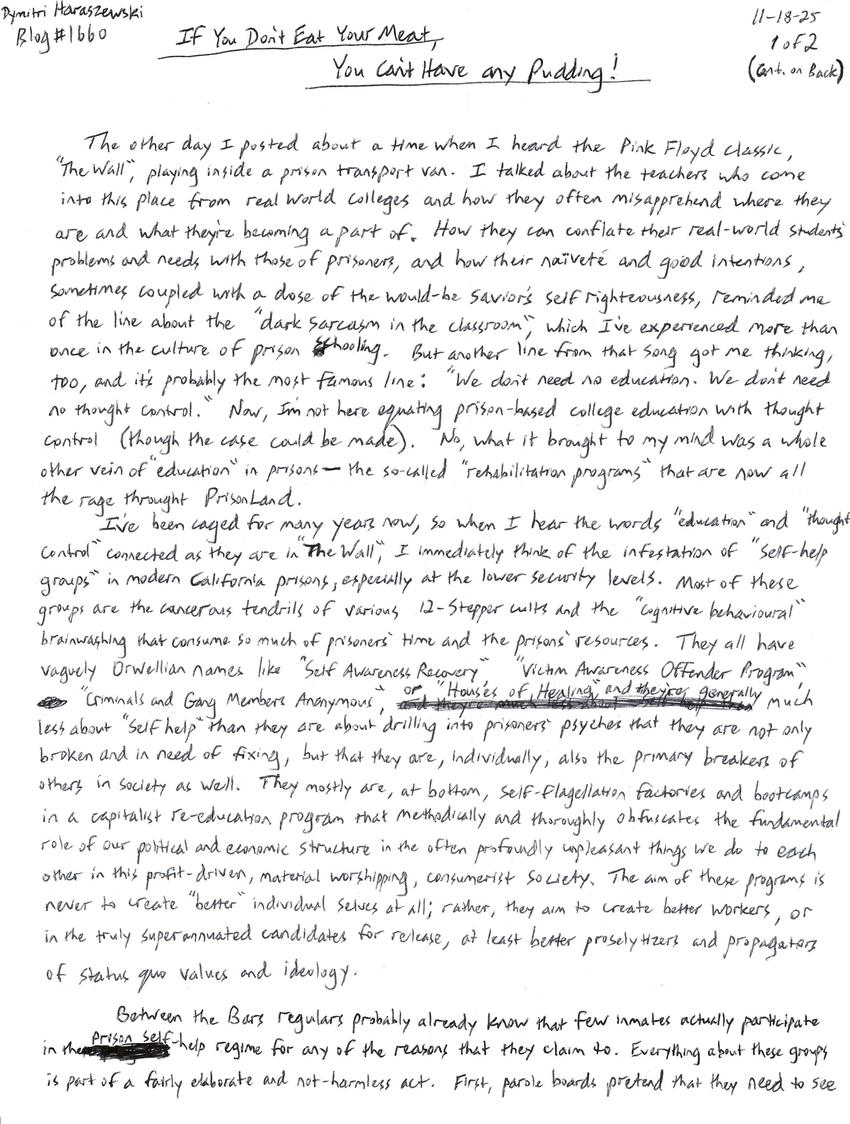
The other day I posted about a time when I heard the Pink Floyd classic, "The Wall", playing inside a prison transport van. I talked about the teachers who come into this place from real world colleges and how they often misapprehend where they are and what they're becoming a part of. How they can conflate their real-world students' problems and needs with those of prisoners, and how their naïveté and good intentions, sometimes coupled with a dose of the would-be savior's self-righteousness, reminded me of the line about the "dark Sarcasm in the classroom", which I've experienced more than once in the culture of prison schooling. But another line from that song got me thinking, too, and it's probably the most famous line: "We don't need no education. We don't need no thought control. Now, I'm not equating here prison-based college education with thought control (though the case could be made). No, what it brought to my mind was a whole other vein of education in prisons—the so-called "rehabilitation programs" that are now all the rage throughout PrisonLand.
I've been caged for many years now, so when I hear the words "education" and "thought control" connected as they are in The Wall, I immediately think of the infestation of "Self-help groups" in modern California prisons, especially at the lower security levels. Most of these groups are the cancerous tendrils of various 12-Stepper cults and the "Cognitive behavioural" brainwashing that consume so much of prisoners' time and the prisons' resources. They all have vaguely Orwellian names like "Self Awareness Recovery Victim Awareness Offender Program"; "Criminals and Gang Members Anonymous"; and of "Houses of Healing", and they are generally much less about "Self help" than they are about drilling into prisoners' psyches that they are not only broken and in need of fixing, but that they are, individually, also the primary breakers of others in society as well. These programs mostly are, at bottom, self-flagellation factories and bootcamps for a capitalist re-education program that methodically and thoroughly obfuscates the fundamental role of our political and economic structure in the often profoundly unpleasant things we do to each other in this profit-driven, material-worshipping, consumerist society. The aim of these programs is never to create "better" individual selves at all; rather, they aim to create better workers, or in the truly superannuated candidates for release, at least better proselytizers and propagators of status quo values and ideology.
Between the Bars regulars probably already know that few inmates actually participate in the prison self-help regime for any of the reasons that they claim to. Everything about these groups is part of a fairly elaborate and not-harmless act. First, parole boards pretend that they need to see
2 of 2
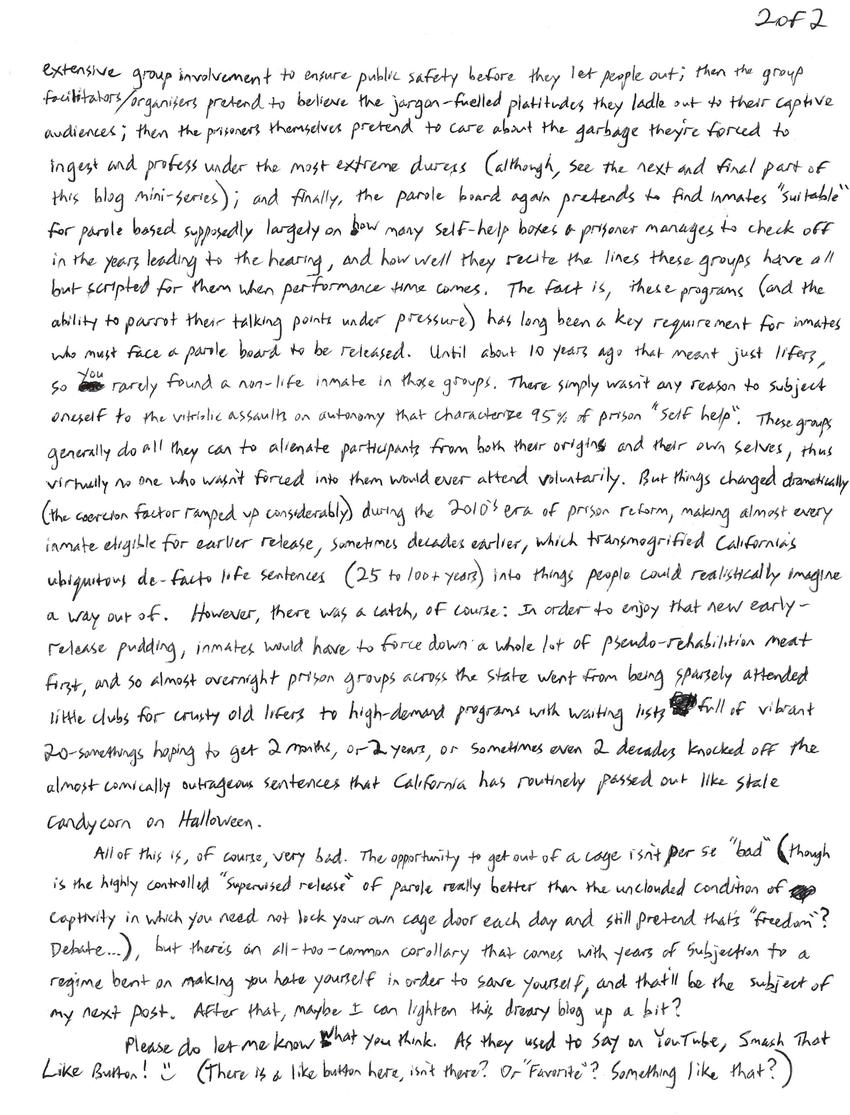
extensive group involvement to ensure public safety before they let people out; then the group facilitators/organizers pretend to believe the jargon-fuelled platitudes they ladle out to their captive audiences; then the prisoners themselves pretend to care about the garbage they're forced to ingest and profess to believe under the most extreme duress (although, see the next and final part of this blog mini-series). Finally, the parole board again pretends to find inmates "suitable" for parole based supposedly largely on how many self-help boxes a prisoner manages to check off in the years leading to the hearing, and how well they recite the lines these groups have all but scripted for them when performance time comes. The fact is, these programs (and the ability to parrot their talking points under pressure) has long been a key requirement for inmates who must face a parole board to be released. Until about 10 years ago that meant just lifers, so one rarely found non-life inmates in those groups. There simply wasn't any reason to subject oneself to the vitriolic assaults on autonomy that characterize 95% of prison "Self help". These groups generally do all they can to alienate participants from both their origins and their own selves, thus virtually no one who wasn't forced into that world would ever attend voluntarily. But things changed dramatically during the 2010's era of prison reform, the coercion factor ramping up considerably as almost every inmate suddenly became eligible for early release, sometimes decades earlier than expected. All of this transmogrified California's ubiquitous de-facto life sentences (25 to 100 years) into things that people could realistically imagine a way out of. However, there was a catch, of course: In order to enjoy their new early-release pudding, inmates would have to force down a whole lot of pseudo-rehabilition meat first, and so almost overnight prison groups across the state went from being sparsely attended little clubs for crusty old lifers to high-demand programs with waiting lists full of vibrant 20-somethings hoping to get 2 months, or 2 years, or sometimes even 2 decades knocked off the comically outrageous sentences that California has routinely passed out like stale Candycorn on Halloween.
All of this is, of course, very bad. The opportunity to get out of a cage isn't per se "bad" (though is the highly controlled "supervised release" of parole really better than the unclouded condition of captivity in which you need not lock your own cage door each day and still pretend that is "freedom"? Please debate...), but there's an all-too-common corollary that comes with years of subjection to a regime bent on making you hate yourself in order to save yourself, and that'll be the subject of my next post. After that, maybe I can lighten this dreary blog up a bit?
Please do let me know what you think. As they used to way on YouTube, Smash That Like Button!" (There is a like button here, isn't there? Or "Favorite? Something like that?)
Other posts by this author
|
2026 sep 28
|
2026 sep 27
|
2026 sep 13
|
2026 sep 13
|
2026 aug 30
|
2026 aug 30
|
More... |
 RSS
RSS
Replies (2)
Merry Christmas!