

Transcription
Johnny E. Mahaffey
December 7, 2025
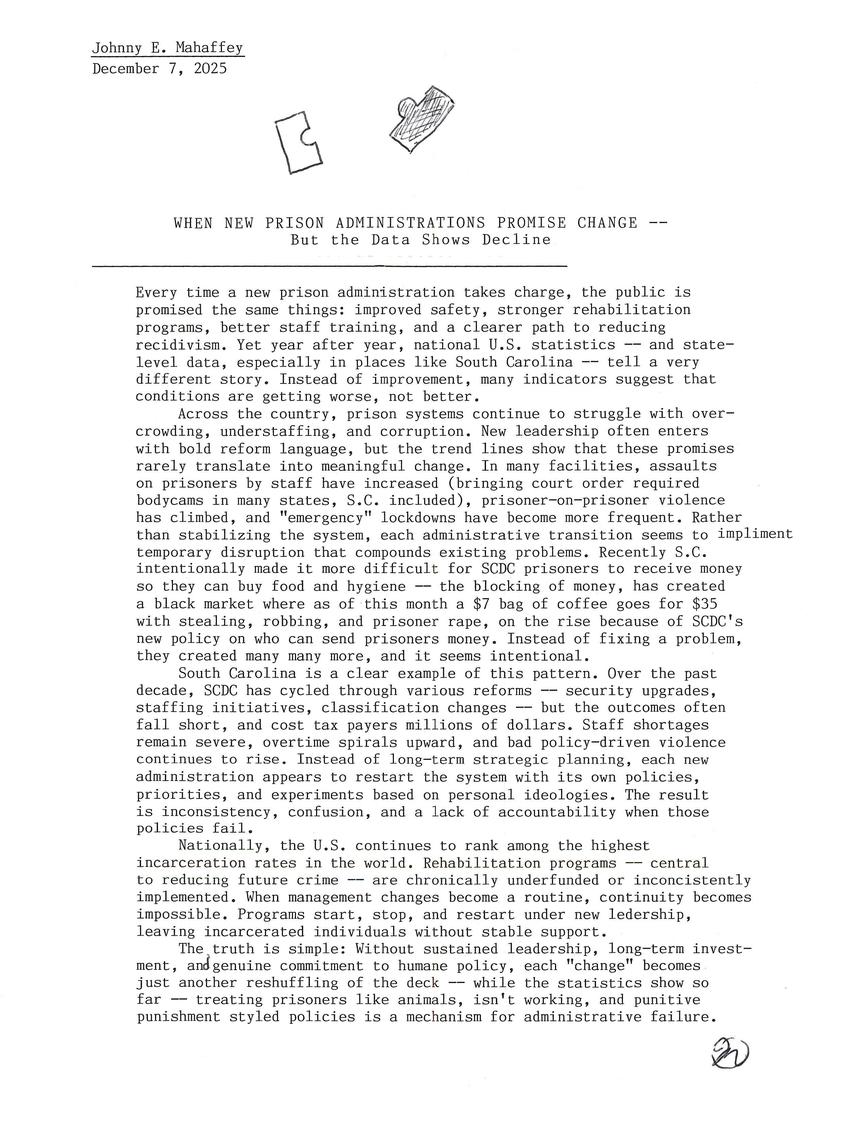
WHEN NEW PRISON ADMINISTRATIONS PROMISE CHANGE --
But the Data Shows Decline
Every time a new prison administration takes charge, the public is promised the same things: improved safety, stronger rehabilitation programs, better staff training, and a clearer path to reducing recidivism. Yet year after year, national U.S. statistics -- and state-level data, especially in places like South Carolina -- tell a very different story. Instead of improvement, many indicators suggest that conditions are getting worse, not better.
Across the country, prison systems continue to struggle with over-crowding, understaffing, and corruption. New leadership often enters with bold reform language, but the trend lines show that these promises rarely translate into meaningful change. In many facilities, assaults on prisoners by staff have increased (bringing court order required bodycams in many states, S.C. included), prisoner-on-prisoner violence has climbed, and "emergency" lockdowns have become more frequent. Rather than stabilizing the system, each administrative transition seems to implement temporary disruption that compounds existing problems. Recently S.C. intentionally made it more difficult for SCDC prisoners to receive money so they can buy food and hygiene -- the blocking of money, has created a black market where as of this month a $7 bag of coffee goes for $35 with stealing, robbing, and prisoner rape, on the rise because of SCDC's new policy on who can send prisoners money. Instead of fixing a problem, they created many many more, and it seems intentional.
South Carolina is a clear example of this pattern. Over the past decade, SCDC has cycled through various reforms -- security upgrades, staffing initiatives, classification changes -- but the outcomes often fall short, and cost tax payers millions of dollars. Staff shortages remain severe, overtime spirals upward, and bad policy-driven violence continues to rise. Instead of long-term strategic planning, each new administration appears to restart the system with its own policies, priorities, and experiments based on personal ideologies. The result is inconsistency, confusion, and a lack of accountability when those policies fail.
Nationally, the U.S. continues to rank among the highest incarceration rates in the world. Rehabilitation programs -- central to reducing future crime -- are chronically underfunded or inconsistently implemented. When management changes become a routine, continuity becomes impossible. Programs start, stop, and restart under new leadership, leaving incarcerated individuals without stable support.
The truth is simple: Without sustained leadership, long-term investment, and genuine commitment to humane policy, each "change" becomes just another reshuffling of the deck -- while the statistics show so far -- treating prisoners like animals, isn't working, and punitive punishment style policies is a mechanism for administrative failure.
Other posts by this author
|
2026 aug 7
|
2026 jul 14
|
2026 jun 7
|
2026 may 27
|
2025 dec 3
|
2025 nov 30
|
More... |
 RSS
RSS
Replies (4)
your son
~ Collin Johnny Mahaffey
I will not tell you my life story here or anything. many stupid and great and terrible things have happened, let's just leave it at that. I will tell you what I read and have been doing so that you at least know me like I know you from these blogs. I've known about the existence of this blog since 9th grade but I never examined any of it until now, believing myself immature to form a reasonable opinion at that time. I've never deeply visited my family's history because I never wanted to cause anyone pain, and I still don't. I believe the beautifully absurd and wonderful trajectory of my life and how it is playing out amidst all the stupidity of what's going on the world has motivated me to write this. I have a paper due at midnight I could be working on but I will deal with that in a couple hours--we're looking at examples of works we read in my major American authors class and just forming opinions about them, there's three prompts, haven't decided on one, probably going to write about Poe's The Fall Of The House Of Usher (prepare for a long yapathon about the books I enjoy.)--so then, what exactly do I do: I spend every week and have been for the past 8 months living on a college campus where my opinion matters and I can publish my work with Winthrop's help, where I'm fed unreasonably well to the point where I've gained a few pounds, have been dropping weight since now because I've just genuinely not felt like eating too much anymore. Anyway, I'm fed, I sleep wonderfully, I have really good friends, and I can walk to my library--can I just say having a college library across from your dorm hall is the greatest thing ever?--and simply chill in there, read, write, etc. I haven't been writing and reading much except for essays and college reading of course, so I'm trying to get back on making that a habit. My schedule is very good, I only have four days of classes and a three day weekend, plus my classes have a lot of free time in between, I only have 2-3 classes a day. I've been told I would make a wonderful English teacher, but I've been mainly focusing on my English degree (they don't offer creative writing majors here, they think of it more as a specialization, I'm very likely going to change my minor back to that because I oddly didn't think of it when asked what I wanted to minor in.) My high school's entire English department rode on me to do college and major in English, become a writer, etc. which has been my goal for so long now. I've read everything from Dostoevsky to Tolstoy to Kafka to Tolkien to Dickens to McCarthy to--my two favorites, whose bibliographies my eyeballs have consumed half of--Faulkner and Camus. In short, life is going quite wonderfully, and I'm losing room to type, but this is a fine enough letter as is. I hope you enjoyed knowing me and I hope you have a good rest of your life
I forgive you.
~ your son